
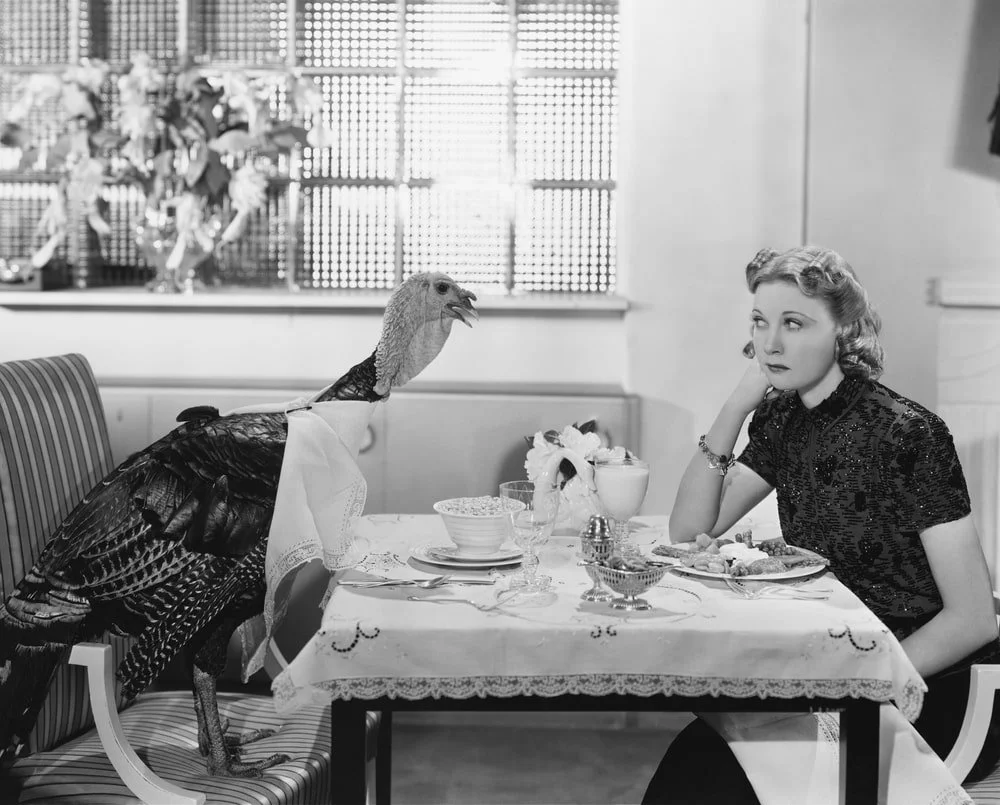
🦃 You Quit First
You probably didn't announce it. There was no farewell post and no dramatic deletion video. You just stopped opening the app quite so often, and started saying yes to things that happen in actual rooms, on commons, and in pubs.
In London, that looks a little different than anywhere else. This is not one city. It is dozens of villages that grew together and share a transport system. Cross-city dating is long-distance here: nearly half of Londoners consider it long-distance, and nearly 7 in 10 prefer dating someone in their own area. Most Londoners will not travel more than 30 to 45 minutes for a first date.
Turns out you weren't alone. You were early. This fall, the dating industry has spent a great deal of money admitting what you already worked out: Tinder has an Events tab, Bumble sold for a tenth of its peak value, and every study says singles want to meet in person again. So this Thanksgiving, while everyone else is talking turkey, we'd like to talk about the people who quit cold turkey first. That's you.
📍 Tinder Discovered the Room
In March, Tinder launched Events, a tab inside the app for finding in-person experiences in your city. It started in Los Angeles, where 66% of eligible active users engaged with it and a 60-person candlelight ceramics class sold out within a day.
Then it spread. In August, Tinder's parent company told analysts it expected to reach 75 cities by the end of 2026. Match Group's CEO now says Events is live in more than 50 cities, with London expected next.
London is expected to be the first UK market, but there is no confirmed launch date as of October 2026, so this is the city still waiting for the tab to arrive. The walk-away is already measured, though. Tinder's UK adult users fell from 2.49 million in May 2023 to 1.9 million in May 2024. Hinge fell from 1.51 million to 1.4 million over the same period, and Bumble from 1.44 million to 1.1 million. About 5 million UK adults used a dating platform in 2024, down 16% year on year, with fatigue cited as the reason.
Tinder's events are run by partner providers; the app makes them discoverable rather than hosting them itself.
Nineteen years ago, people said in-person dating was old-fashioned. This year, the biggest dating app in the world built a tab for it.
🏷️ The Biggest Markdown of the Season
Black Friday is still weeks away, and the dating industry already has its doorbuster.
In October, Bumble announced it is being acquired by Ithaca Holdings for $1.3 billion and will go private. When it went public in 2021, it was valued at around $15 billion. That's a markdown of roughly 90%. No coupon code required. Its most recent quarterly report explains why: revenue fell 15.2% year over year, and paying subscribers fell 16.4%, to about 3.2 million.
We're not gloating. Bumble pushed women-first dating into the mainstream, and that mattered. But a tenth of its peak value says a lot of people made a different move: they stopped swiping and started showing up.
And in London, that move has its own price tag. First-date drinks typically run 40 to 60 pounds for two, and dinner 80 to 150 pounds. The Single Tax Score here is 61, and a solo date runs about $108. More than half of people in a 2026 State of Our Unions survey cited money as their biggest barrier to dating. A 90% markdown on a dating app is one thing. Spending 40 to 60 pounds on drinks with someone you met on it is another.
📉 The Numbers Behind the Exit
The apps aren't changing course on a whim. The data has been pointing this way for a while.
- Less time swiping. In the UK, regulator Ofcom found average monthly time on dating services fell from almost four hours in 2023 to three in 2025.
- Connection feels harder. In Match Group's Spark Study of 3,007 UK singles, 47% said it has never been harder to connect, and 43% said most of their social time happens behind a screen.
- Meeting someone new has become rare. In the same study, 32% of singles met nobody new in person in the past month.
- People want the room back. Match Group research found 61% of UK single adults would like more of their social life to happen face to face.
- The happy ending is deleting the app. 56% of singles in the Spark Study see deleting a dating app after finding a partner as the modern happy ending.
Nobody fell out of love with love. They fell out of love with the admin.
And London is the city where that story is loudest in a different way. The 2021 Census found 37.9% of adults in England and Wales never married or in a civil partnership, 18.4 million people. In London, 29.3% of households are one person living alone, rising to 51.0% in the City of London and 56.5% in Strand, St James, and Mayfair. Marriage rates in London have fallen by roughly half over 35 years. Yet only 11% of Brits met their partner online, while 53% found love through in-person encounters, and 57% of 18 to 25 year olds transitioned from friendship to romance. A 2024 YouGov survey found 43% overwhelmed by app dating, and 54% of women who used platforms in the past year felt overwhelmed by messages.
The rest of the country is catching up. Eventbrite tracked a 117% jump in U.S. events using "meet cute" language in the first half of 2026, with attendance up 128%. Tinder's own research found 48% of Gen Z singles deleted every dating app they had in 2024. London didn't start this. It just felt it first, because here the stakes are highest: the most villages, the longest cross-city journeys, and the least patience for wasting either.
📋 Your Checklist Is the Leftovers
Here's the twist: even as people leave the apps, plenty are still carrying the app mindset with them. The new Singles in America study from the Kinsey Institute and Match found the share of singles with a "checklist" for a long-term partner rose from 25% in 2021 to 34% in 2026. That's the swiping mentality, reheated. Filters. Must-haves. A height minimum typed into a box.
The data says something different. In our own event data, 42% of matches happen outside the "type" people describe before the event. Because a checklist can't measure how someone laughs, whether they listen, or how a conversation feels four minutes in. The same study has a hopeful note: 41% of singles are now willing to try a second date when the first one isn't exciting, up from 35% in 2021.
In London, the checklist has a local flavor. Hinge data from 2026 found 84% of Gen Z daters want new ways of building meaningful connections, and 70% of Hinge UK users said a shared interest is essential before a first date. The resume version of a person works in a meeting. Across a table, it lands like a performance. So if you're quitting the apps cold turkey, quit the checklist with them. Leave the leftovers in the fridge.
🍽️ Thanksgiving Was the Original In-Person Event, London Edition
Think about what Thanksgiving actually is. A table. A room full of people. Conversation that wanders wherever it likes. Nobody gets to filter who sits next to them, and somehow the best moments are usually the unplanned ones.
That's all a good speed dating night is, really. A room, a host, a series of real conversations, and a Smart-Card that only counts a match when both people mean it. No algorithm deciding who you're allowed to meet. No three-week text thread before you find out whether there's a spark.
In London, that room changes with the neighbourhood, and the neighbourhood is half the story. Shoreditch, Dalston, and Hackney are creative, nightlife, 20s. Clapham, Balham, and Battersea are young professionals, Sunday roasts and Common walks as the default second date. Peckham and Brixton are rooftop bars and live music. Soho and Covent Garden are neutral middle ground. North London, Camden, Islington, and Hampstead, is creative, young families, pricey brunches. West London, Notting Hill, Kensington, and Chelsea, is wealthier, older, more traditional. The City and Canary Wharf are finance workers. Cross-river dating, North against South, is a legitimate relationship obstacle.
And then there's the river tax, the part only Londoners understand. A match across the river sounds fine on a map and means real transit time, a rescheduled plan, and sometimes a date that quietly falls apart before it starts. A room in your own village does something a feed never could: it puts the person in front of you before the logistics get a vote.
And it's not just speed dating. The same impulse is sending people to running clubs, supper clubs, museum nights, art workshops, and live music. Speed dating events sell out, and supper clubs draw crowds, with one Dalston event drawing 120 attendees. The point isn't the format. It's that people are finally coming outside and meeting each other face to face, in places that were built for that in the first place.
💛 One Last Cheeky Thought
London has nearly 9 million people, and a dating rule that says the other side of the river is long-distance. Both things are true, and that is the whole paradox.
The problem was never supply. It was the screen, and the journey. Almost nine million people, and the thing that wasn't working was the way they were meeting, or rather the way they weren't.
The people who quit first figured that out before the industry did. They stopped paying 40 to 60 pounds for drinks with a profile and started showing up in their own villages, in pubs and on commons and at supper clubs, where a conversation costs nothing and a second date is a walk, not a cross-city expedition.
The apps are going cold turkey. Tinder built an Events tab and London is expected next. Bumble got marked down. Every new study says the same thing.
You just got there first.
🦃 CheekyTurkey: Quit Cold Turkey, Save 35%
Ready to make it official? Use code CHEEKYTURKEY at checkout for:
- 35% off Curated Introductions: real people from our events and our own program, with the date planned for you.
- 35% off Luxury Matchmaking by Luvo, our sister service: a dedicated matchmaker and founder-guided introductions.
The offer runs through Cyber Monday, November 30. After that, the turkey's carved.
Plus, the Match Guarantee is back. Attend any standard MyCheekyDate event in November, leave with at least one mutual match, and your next event is on us. Just email info@mycheekydate.com once you've spotted the one you want.
📊 Sources
Tinder Events figures: Tinder and Match Group announcements, 2026, via Fast Company, TechCrunch, Marketing Dive, and LBC. Bumble figures via MediaPost, October 2026. UK figures from Ofcom and Match Group's Spark Study (3,007 UK single adults, Strand Partners), via Global Dating Insights, the BBC, and LBC. Checklist and second-date figures from the Kinsey Institute and Match's 15th annual Singles in America study (about 5,000 U.S. singles, March-April 2026). London dating figures from the Bumble and Lime 2025 poll; UK app-user declines from Ofcom data, May 2023 to May 2024; Census 2021 figures for England and Wales; London population from the London Datastore, 2023. In-person meeting figures and app-overwhelm figures from YouGov, 2024; Hinge 2026 data. Eventbrite figures via American Almanac (October 2026). The 42% outside-stated-type figure reflects the full MyCheekyDate Smart-Card dataset, weighted toward the most recent 24 months.