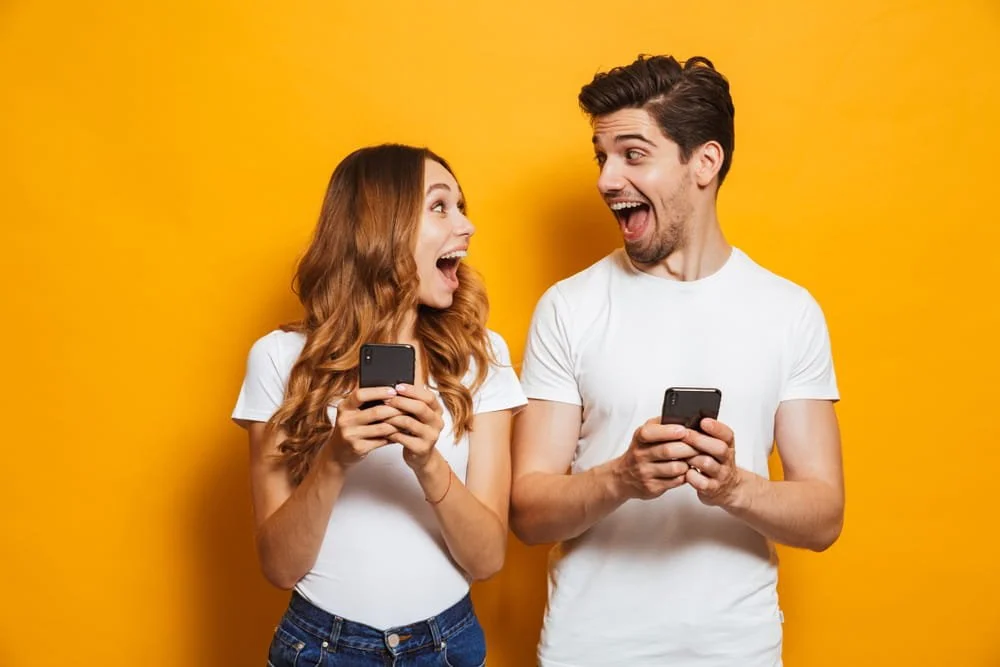
Or: why your talking stage currently consists of one person typing "haha" somewhere in Shoreditch and another person trying to decode it like it's a lost Rosetta Stone fragment, on a delayed Northern Line train, in the dark.
📱 Let's Begin With Something Uncomfortable
You are not "getting to know" someone.
You are conducting a small, carefully managed public relations campaign.
Every text is reviewed. Every emoji is considered. Every "haha" has been through more internal deliberation than a parliamentary committee. You've rewritten messages. You've deleted messages. You've typed "Sounds lovely!" and then spent nine minutes deciding whether "lovely" made you sound like someone's nan.
Meanwhile they're doing exactly the same thing.
From a different postcode.
Welcome to dating in London: two people pretending not to care while caring so intensely they're researching punctuation, separated by four tube stops that somehow always take forty minutes.
A Harvard study found that 94% of millennials report texting-related anxiety. Not mild inconvenience. Anxiety. About messages they are choosing to send. To people they are allegedly pursuing romantically.
In London, where emotional restraint is practically a civic value, that number feels both entirely accurate and deeply relatable.
🎭 The Talking Stage Is Community Theatre, London Edition
We've all agreed to call it a "talking stage."
Which in London is particularly generous, because Londoners have a specific and magnificent gift for communicating enormous amounts of nothing with great efficiency.
Two strangers match. They spend somewhere between three days and the entire reign of a monarch exchanging carefully understated updates about their week.
"How was your week?"
"Not bad, actually. Busy."
"Yeah, same. Work's been mad."
Extraordinary. Two souls, connected.
The remarkable thing is that both people often leave these conversations convinced they have chemistry. With whom? With a version of that person assembled from their profile photos, their Spotify Wrapped, their tagged location at that one natural wine bar in Peckham, and two hundred and fifty messages of studied understatement.
London daters know more about each other's taste in restaurants than their actual personalities. This is by design. Vulnerability in London is rationed carefully, like a good broadband connection — theoretically available, frequently unreliable, and occasionally dropping out entirely without explanation.
The average talking stage before a first date now runs two to six weeks. Bumble's internal analytics found that stages exceeding three months correlate with a 70% fizzle rate. In London, three months is practically a common-law arrangement. You've built an entire emotional infrastructure around someone you've never met, assigned them qualities they may not possess, and then — in true London fashion — said absolutely nothing about any of it.
A 2025 Psychology Today survey found that mismatched goals cause 62% of stalled talking stages. Not incompatibility. Not distance — though in London, distance is absolutely a factor and we will address the Zone 2/Zone 4 question shortly. Mismatched goals. Two people who both claim to want connection, circling each other over text, because neither is sure how seriously the other means it.
The talking stage doesn't clarify this.
It just produces more material for a very restrained conversation with a friend over a pint.
😬 The Double Text Isn't Confidence, Darling
Let's be honest about something.
The double text isn't embarrassing.
The internal monologue that happens before the double text is embarrassing.
You know the one.
You send a message. Twenty minutes pass. Nothing. An hour passes. Nothing. You check whether they've viewed your WhatsApp status. You've looked at their Instagram story viewer list. You've opened and closed the conversation three times while maintaining an entirely composed exterior on the outside because you are in public in London and one simply does not.
You've convinced yourself they've gone to the countryside for the weekend without mentioning it.
Then they reply:
"Sorry, was on the Tube."
Three hours of restrained emotional gymnastics. One extremely plausible London explanation.
This is what the talking stage actually produces: not intimacy, but a slow, low-grade anxiety that Londoners have normalised as part of getting to know someone — which is saying something, because Londoners have an extremely high tolerance for ambient discomfort. 43% of men and 26% of women admit to feeling genuinely drained by extended pre-date texting. They're not playing it cool. They're exhausted.
The person managing four simultaneous talking stages while appearing completely fine about it on the outside is not a confident dater.
They are a very tired person with an Oyster card and good signal on the Overground.
🇬🇧 London Has Turned Emotional Unavailability Into An Aesthetic
Let's name the thing that makes the London talking stage specifically distinctive.
In Los Angeles, people perform warmth and feel anxious underneath.
In London, people perform indifference and feel anxious underneath.
Both cities have arrived at the same destination via different cultural motorways.
London daters have elevated the art of seeming unbothered to a level that borders on performance art. The measured response. The studied casualness. The reply that is warm enough to keep things going but cool enough to maintain complete deniability about whether you're actually interested.
"Might be around. Could be fun."
This is London for: I have thought about little else since you messaged.
And because everyone in London is doing this simultaneously, you end up with two people who are genuinely interested in each other, both performing disinterest with extraordinary commitment, both interpreting the other's performance as genuine disinterest, and both quietly ghosting someone they actually liked because the signals got completely lost in translation.
A therapist writing in Psychology Today described it precisely: "Many clients try to manage uncertainty by overthinking every message, hoping that a 'perfect' response will somehow manufacture a sense of control. This performance actually fuels anxiety rather than fixing it."
In London, the performance is so culturally embedded that most people don't realise they're doing it.
Which is exactly why face-to-face cuts through it so effectively. You cannot perform indifference at someone who is making you laugh across a table in Soho.
🗺️ The Zone Problem Is Real And Also A Metaphor
There is a conversation that happens at every London event we host.
"Where are you based?"
"Shoreditch."
"Oh. I'm in Clapham."
[Internal calculation: Zone 1 to Zone 2, theoretically manageable, except the Northern Line is being part-suspended this weekend and the replacement bus service adds thirty-seven minutes and somehow always smells of someone else's evening.]
"That's... not too bad."
It is absolutely too bad and both people know it.
London's geography does to dating what the talking stage does to chemistry — it creates distance that feels permanent before anyone has established whether there's a reason to cross it.
But here is what nineteen years of running events in this city has shown us: the Zone barrier is almost entirely a text-era problem.
When people meet in person first — when there's actual warmth, actual laughter, an actual reason to care — the Northern Line becomes navigable. We have matched people across every postcode divide in London. We have watched someone from Hackney cheerfully commit to regular trips to Wimbledon. We have seen a Kensington resident discover, to their own surprise, that Dalston is actually fine and they were being dramatic.
But you cannot fall for someone you've never met.
You can fall for a text thread. The thread doesn't care about rail replacement services.
The person does. And they deserve to meet you before deciding you're worth the journey.
😏 The Person Who's Amazing At Texting Isn't Always Amazing At Dating
This is the thing nobody wants to admit over a flat white in Bermondsey.
Text chemistry and real chemistry are cousins at best.
We've watched thousands of people meet at MyCheekyDate events across London — Soho, Shoreditch, Covent Garden, Kensington, London Bridge.
The person who writes an absolutely brilliant text conversation? Sometimes magnificent in person. Sometimes about as present as a GP appointment slot in January.
Meanwhile the slightly awkward texter who takes a day and a half to reply because they were doing something actually interesting with their actual life? Often sharp, funny, and impossible to stop talking to once the conversation gets going.
This is not a coincidence.
The people best at texting in London are often the people who've had the most practice managing their presentation at a careful remove. That is a skill. But it is not the same skill as being warm, interesting, and genuinely present with another person across a table. Those things don't transfer automatically.
The numbers make this uncomfortably clear. For every 57 matches on a swipe-based app, research finds just one in-person meeting — less than 2% of matches ever become a date. Only 14% of Hinge matches convert to a first date. A 2025 study found that British singles averaged fewer than two in-person dates in the preceding year, with a substantial proportion reporting zero dates at all.
Not zero matches. Zero dates.
In a city of nine million people where everyone is allegedly looking for connection, an enormous amount of that connection is happening entirely in a chat window and absolutely nowhere else.
78% of dating app users reported feeling emotionally exhausted in 2024. Not from dating. From the performance of almost-dating.
In London, almost-dating has been culturally refined to the point where some people have been in a "talking stage" for so long it predates Brexit.
🧠 What Actually Happens When Londoners Meet Face To Face
Something immediately, noticeably different.
The managed version of a London dater — the one rationing enthusiasm, workshopping casualness, maintaining studied ambiguity across multiple platforms — evaporates in approximately four minutes of actual conversation.
You laugh differently. You stop editing. The understatement gives way to something more real.
This is not an argument. It is what we observe at every single event we run in this city. The person who arrived seeming contained and slightly guarded is, by the third conversation of the evening, genuinely warm and entirely themselves. The performance doesn't survive contact with reality.
A 2024 study from the University of Wisconsin found that people with higher social anxiety specifically prefer texting over in-person interaction in dating contexts — the talking stage exists partly because it feels safer, more controlled, less exposing. For a city that culturally prizes composure, this has a particular resonance.
The problem is that the composed, carefully managed version is the one your match thinks they're meeting.
When the real version shows up — funnier, warmer, more opinionated, more human — the contrast produces one of two outcomes.
Often it's a revelation. The real person is considerably better than the text thread suggested.
Sometimes it's why a date that seemed so promising over WhatsApp feels like a politely endured hour of parallel performance at a bar in Soho.
Three weeks of excellent texting does not produce chemistry. Chemistry is discovered in person. The rest is just content.
💬 What Our Smart-Card Data Shows About London Daters
MyCheekyDate has been running events in London long enough to have a clear picture of how this city dates when the phone is put away and the talking stage is skipped entirely.
Our proprietary Smart-Card system begins from a specific premise: real-world attraction signals — who people are actually drawn to when they're in a room, where mutual interest genuinely appears, how chemistry reveals itself in live conversation — are more accurate than anything a profile, a quiz, or three weeks of WhatsApp can produce.
Here is what makes it different from everything happening on your phone.
There are no profiles to optimise before you're seen. No carefully selected photos. No bio that took four drafts and still doesn't quite capture it. Guests meet face to face first. The performance is removed before the evaluation begins.
Selections are entirely private. Nobody sees who chose whom unless both people chose each other. No one-sided reveals. No public rejection. Everything submitted discreetly from your phone, with the window open until midnight — no rushed decisions at the venue, no awkward hand-in. No app download required.
A match only exists when it's mutual. If one person selects another and the interest doesn't go both ways, nothing is shared. Not a hint. Not a notification. The apps would charge you to know this. The Smart-Card considers it information nobody asked for.
Across our attendees nationally: 86% received at least one mutual match. The average attendee left with 2.3 mutual connections from a single evening. And 77% of guests who received zero matches at their first event matched at their second — not because they reinvented themselves, but because they relaxed enough to stop performing and start connecting.
That last number is the one that says the most about what the talking stage gets wrong. It assumes that more time spent communicating produces more connection. What actually produces more connection is comfort. Presence. The absence of the performance.
The second event removes the performance. The real person shows up. The real person matches.
🔍 What The Smart-Card Sees That The Apps Can't
Because the Smart-Card captures real-world interest signals rather than stated preferences, it builds a more truthful picture of what someone is actually drawn to.
London daters in particular have a significant gap between who they say they want and who they actually respond to in a room.
Someone writes: "Looking for someone professional, ambitious, emotionally intelligent."
Then spends an entire evening gravitating toward the quietly funny person who works in something completely unglamorous, asks excellent questions, and makes them laugh about the commute.
The talking stage reinforces the stated preference. It builds a connection with the person who matches the criteria on paper and produces the quietly confusing feeling when they finally meet that something isn't quite landing.
The Smart-Card catches the real thing.
Those signals don't just process one evening. They inform what comes next — private select events, CheekySocial evenings, Curated Introductions — where matching is shaped by what you actually responded to in a room, not what you wrote in a profile at 11pm on a Sunday. That is a meaningfully different kind of matchmaking. Especially in a city where people are very good at articulating their requirements and very surprising when it comes to who they actually connect with.
⌚ Why Wearables Are About To Make Everything Considerably More Exhausting
This is coming, and London will not be exempt.
Wearable technology already collects significant physiological data — heart rate, skin conductance, stress markers. The next generation of consumer devices will read these signals with increasing precision. Apple Watch. Oura Ring. The technology exists. The integration with communication contexts is a matter of time.
Here is the problem this creates for the talking stage.
Not only will people be carefully composing the message. They'll be managing whether the device on their wrist is betraying it.
Heart rate elevated when the notification appeared? The device knows. Stress markers climbing while you compose the reply you're trying to make look effortless? The device knows. The three-hour gap designed to signal that classically London combination of interest and indifference, while your cortisol levels are doing something entirely different?
The device absolutely knows.
In a city where the gap between how people present and how they actually feel is already doing significant structural work, the arrival of biometric data in dating contexts is going to be interesting.
Your Apple Watch will know you cared before you admitted it to yourself.
The exhaustion of managing a digital self across multiple platforms and multiple talking stages is already driving people back toward in-person dating at measurable scale. In the UK, 1.4 million people left dating apps between 2023 and 2024, gravitating toward in-person alternatives. The trend was already moving before wearables arrived.
The more performative digital dating becomes, the more powerfully simple it feels to be in a room with someone.
London's nervous systems have been trying to say this for a while.
🚇 The Radical Act of Just Meeting Someone In This City
There is a version of dating in London where you spend three weeks carefully managing someone's impression of you via WhatsApp, build a connection that exists entirely in the chat, invest real emotional energy in a stranger, take a tube and a bus and a mild amount of Zone-related existential calculation to finally meet them, discover within the first drink that the chemistry you both projected onto the text exchange doesn't exist in person, and then make the journey home on the Overground at half ten on a Wednesday sitting with the quiet disappointment of it.
This is what a significant number of London daters are doing regularly.
There is another version.
You show up to an event in a well-chosen room somewhere in Soho or Shoreditch or Covent Garden. You have four minutes with a real person. You either feel something or you don't. You find out immediately — before the zone calculation, before the three-week investment, before the WhatsApp thread that goes nowhere specific. You move on if there's nothing. You record mutual interest privately if there is.
No journey home processing a text thread.
No wondering what "might be around" actually meant.
Is there something here, in person? Find out in four minutes rather than four weeks.
The Smart-Card data shows attendees leave with an average of 2.3 mutual connections from one evening. No talking stage. No emoji archaeology. No wondering whether "haha" with two h's means something different from "haha" with one.
Just mutual. Or not. Clear. Immediate. Private.
Chemistry does not live in the chat.
It never did.
And in London, it definitely doesn't live in a WhatsApp thread between Shoreditch and Clapham that's been running since March.
💛 One Last Cheeky Thought
London is a city of nine million people in which an enormous number of them feel, at some point on a Tuesday evening, genuinely quite lonely.
Not for want of people. The city is absolutely full of people. Extraordinarily interesting, complicated, culturally specific people from every corner of the world, all on the same tube, all looking at their phones, all technically available.
The problem is not the number of people.
The problem is the medium.
Text strips out the tone, the timing, the eye contact, the spontaneous laugh, the ease or friction of a conversation — all the actual signals of connection — and replaces them with a performance that the most anxious and emotionally guarded people in any room are often best at delivering.
In London, that's quite a few people.
The antidote is not a better opener.
It is not a more strategically timed reply.
It is not decoding whether "could be nice" means yes or maybe or the particular London variant of yes-but-I-need-a-fortnight-to-confirm.
It's being in a room, being yourself — the unedited, unguarded, slightly less composed version — and letting someone meet the actual you.
Which, in our experience, is considerably more attractive than the performance.
Every single time.
Including in London.
Especially in London.
Ready to skip the WhatsApp theatre and just meet someone? MyCheekyDate hosts boutique, host-led speed dating events across London — Soho, Shoreditch, Covent Garden, Kensington, London Bridge, and more. No curated bios, no talking stages, no three-week text relationship that quietly dies on a Thursday. Just real people, chic venues, four unscripted minutes, and a Smart-Card that handles the matching privately and mutually. The journey is worth it. Find your next London event at mycheekydate.com/speed-dating-london-events.